

So Sew Easy Schlep Bag – Part 5

Advertisements:

Isn't it amazing the results you get after stitching those twisted seams? That's when you feel like you're making progress toward an actual bag rather than a strange looking pinwheel with no possible use.


Hopefully your bag looks like this.


Now we'll work with the fabric and batting strips you cut for the handles and get started on those.


Fold the fabric strips for the straps in half lengthwise, wrong sides together and press to form a crease down the center.


Fuse the batting strip to the wrong side of the upper half (or left side if the strip is in a vertical position) of the handle aligning the edge of the batting along the pressed fold line. I used a press cloth when fusing the batting to the fabric.

Fold the top (left) edge of the fabric strip down over the batting and press to hold in place.

Fold the bottom (right) edge of the strip over to meet the edge of the batting along the center fold line. The raw edge of the fabric will be along the center fold.

Bring the folded edges of the fabric together, or almost together in this case, and press. I know you're wondering why the two fold lines don't come all the way together. I did this on purpose because I like a nice clean edge on both sides of the strap but also want the durability of the double fabric. If you'd like the edges to meet, cut your handle strips 1/2" wider.

Topstitch right next to the folded edge. It should be about 3/8" from the edge of the handle which makes it easy to stitch by following the seam guide on your sewing machine. Topstitch 3/8" from the edge on the opposite side of the handle.

If one row of topstitching on each side is good then two rows is better! I might stitch right down the middle too.
I've used several things other than fusible batting for stability in the straps. Denim, acrylic felt, wide elastic, flannel and cotton or acrylic webbing also work well.

Read full storyComments { 1 }

So Sew Easy Schlep Bag – Part 4

Advertisements:

This seems to be the place lots of people get confused about what to sew together. I was scratching my head the first time I made a bag so don't feel bad if you've gotten stuck here.


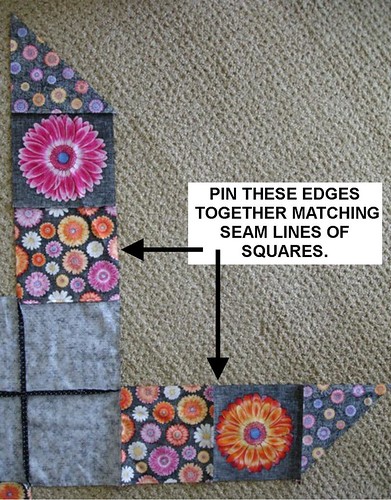
We're going to be bringing these two strips together. The seams that connect the strips appear to twist around the bag after they're sewn.


Pin the seam matching the seams lines of the squares. Isn't it nice how the seam allowances stagger thanks to pressing the seams in alternate directions?


I know it looked like it those two seams weren't going to match up but it's the side of the triangle at the top that gives us the correct length. It's funny how your eyes can play tricks on you with things like this.

You will have those little dog ears at the ends of the triangles. They are supposed to be there. That's how you get the seam allowance around the top of the bag. Because we cut the triangles around the top of the bag from squares, the long edge is a bias edge. Take care when handling this piece. You don't want to stretch out the top of your bag especially if you're going to make one of the reversible ones where you'd be sewing a bias edge to a bias edge later on.

You can start stitching this seam from the triangle edge or from the point where it meets the "C" squares. Because we need to stop our stitching and backstitch at the point where the seam meets the "C" squares I usually look at the wrong side of my "C" fabric and "B" fabric and try to end on the side where I have a better view of the stopping point. In this case I have a better view sewing from the triangles toward the meeting point with my "C" fabric on top rather than starting at that meeting point with the floral "B" fabric on top.

Stitch the seam using a 1/4" seam allowance backstitching at the end of the seam where it meets the "C" squares.

You should have a nice floating seam where the stitching ends. Repeat these steps and sew the remaining three seams.

Read full storyComments { 2 }

So Sew Easy Schlep Bag Tutorial – Part 3

Advertisements:

It's time to lay out the squares and triangles that will form each strip that twists around the outside body of the bag. I've been known to mix up the fabrics or change my mind on something at this point. Now's the time to rearrange things if you're not happy with how things look.


Referring to your fabrics choices for "A" - "B" - "C" and "T", lay your fabrics out in four strips that look like this one.

Using a 1/4" seam allowance, sew four the "C" squares together like you would a four patch quilt block, stopping your stitching 1/4" from the outside edge on all seams. These points are indicated in Fig. 1 on the pattern. Backstitch three or four stitches at those points to secure the end of the seam.

Unlike the 1/4" seams when machine piecing, I want you to press the seams open on the "C" squares.


The four "C" squares should look like this on the wrong side after they are sewn together. Not too exciting yet is it?


At this point you can sew together the "A" and "B" squares using a 1/4" seam allowance. This time you can sew from edge to edge on the seams. Sew a "T" triangle to the top of the "A" squares. You can refer to Fig. 2 on the pattern to make sure you have the triangles going in the right direction. I've messed them up more than once.


It's time to add the strips to the four "C"squares we have ready. Fold back the seam allowance left open at the end of the "C" seam so you can see the raw edge of the square. Pin it in place to help keep it out of the way.


Pin the "B"square (which is the lower edge of the strip), right sides together, to the "C"square matching raw edges.

Stitch using a 1/4" seam allowance starting or stopping at the outer corners of the "C" squares depending on the direction you are sewing the seam.

The outside of the bag should look like this on the right and wrong sides at this point.


Now don't get excited and press all those seams open or even all in one direction. Going clockwise, press the seams of the first strip in one direction and the seams of the next strip in the opposite direction. Continue to alternate pressing on the last two strips.

Take a little break and we'll sew the twisted seams in Part 4.

Read full storyComments { 0 }
169 queries in 1.022 seconds.